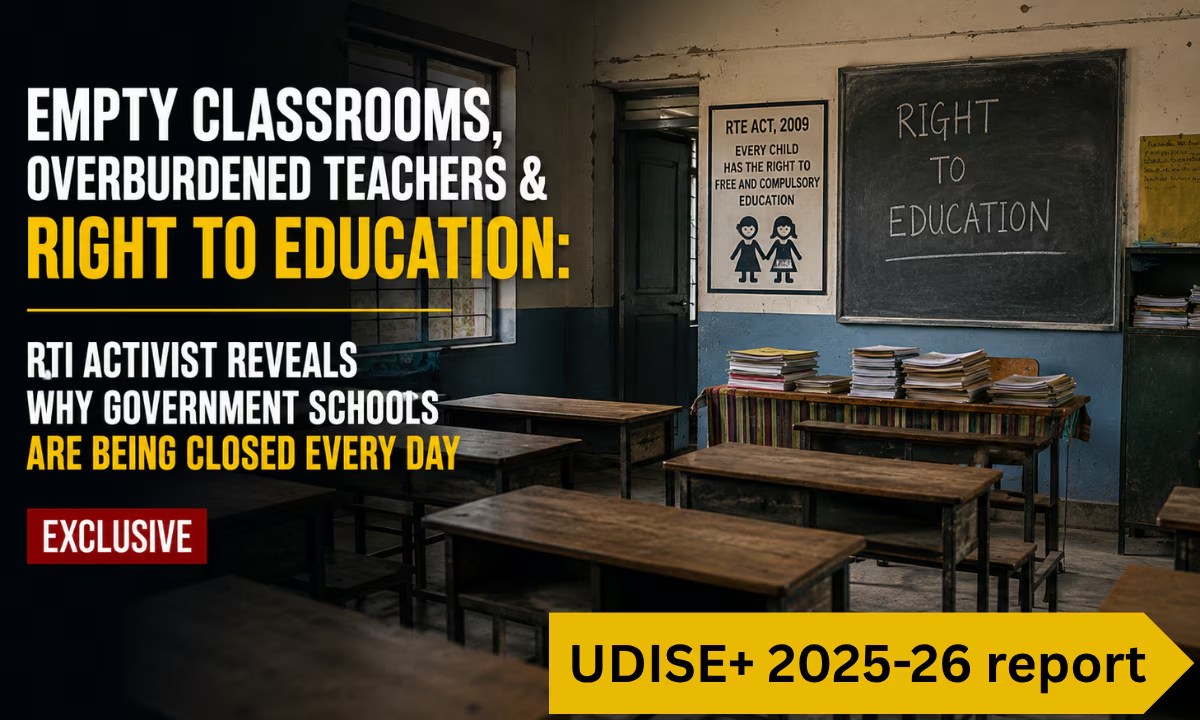
Lawyer and activist Ashok Agarwal breaks down the systemic failures exposed by the latest UDISE+ report, blaming inadequate public investment for India’s deepening government school crisis.
Published: July 8, 2026, 6:50 PM IST
Share Article
https://www.india.com/news/india/empty-classrooms-overburdened-teachers-right-to-education-rti-activist-reveals-why-government-schools-are-being-closed-every-day-exclusive-8468789/
UDISE+ 2025-26 report based interview
New Delhi: Education is widely regarded as the foundation of social mobility and economic progress, yet the quality of schooling continues to shape a child’s opportunities long before they enter the workforce. The latest Unified District Information System for Education Plus (UDISE+) 2025-26 report has brought renewed attention to the condition of India’s school system, flagging thousands of single-teacher and zero-enrolment schools. Against this backdrop, lawyer and education activist Ashok Agarwal argues that the country’s education crisis is rooted in inadequate public investment and the failure to fully implement the Right to Education Act. In this interview, he discusses the challenges confronting government schools and the measures needed to address them.
Unified District Information System for Education Plus (UDISE+) 2025-26 report: Key facts
According to the UDISE+ 2025-26 report released by the Ministry of Education, 1,00,843 schools across India are functioning with only one teacher. Andhra Pradesh has the highest number of such schools (16,357), followed by Jharkhand (9,827) and Punjab (1,749). The report, which covers 14,66,682 schools nationwide, also identified 5,663 schools with zero student enrolment. West Bengal accounts for the largest share of these, with 4,133 schools reporting no enrolment.
Rising school dropout rates and current condition of government schools
On being asked on the situation of rising school dropout rates and condition of government schools, Ashok Agarwal said “The government is not investing in education. The condition of government schools has become so poor that schools are being closed every day. Children are dropping out and enrolment is declining. Recently, during proceedings in the Rajasthan High Court, it was stated that thousands of government schools recorded no enrolment. This is not limited to one state. Across the country, many government schools are witnessing falling enrolment, and that is the reality”.
Agarwal also shared his views on government’s intent to improve the education system of India, “The government has completely failed in implementing the Right to Education. The Act lays down minimum norms for every school. There should be drinking water, electricity, an all-weather building, boundary walls and teachers. These are basic requirements, but many government schools still do not have them. If these minimum standards are not being met, then the Right to Education is not being implemented in its true sense”.
Why are schools being merged in several states of India?
“Thousands of schools are being closed or merged in the name of rationalisation, while enrolment is continuously falling. Those parents who can afford private schools are moving their children there, but not every child has that option. Many children are dropping out of the government school system. The number of out-of-school children remains very high, yet there is no serious effort to bring them back into schools. This is the real impact of weakening the government school system”, Agarwal said.
How serious is the Zero enrolment issue?
“Zero enrolment is a serious warning sign. It reflects the declining condition of government schools and falling enrolment across the country. This is not confined to one state. When government schools are weakened, children are pushed out of the education system instead of being brought into it.”
As the UDISE+ report raises fresh questions about the state of public education, Ashok Agarwal believes the focus must shift from policy announcements to implementation. His central argument is that unless the Right to Education Act is enforced in letter and spirit, government schools will continue to struggle with declining enrolment, inadequate infrastructure and teacher shortages.