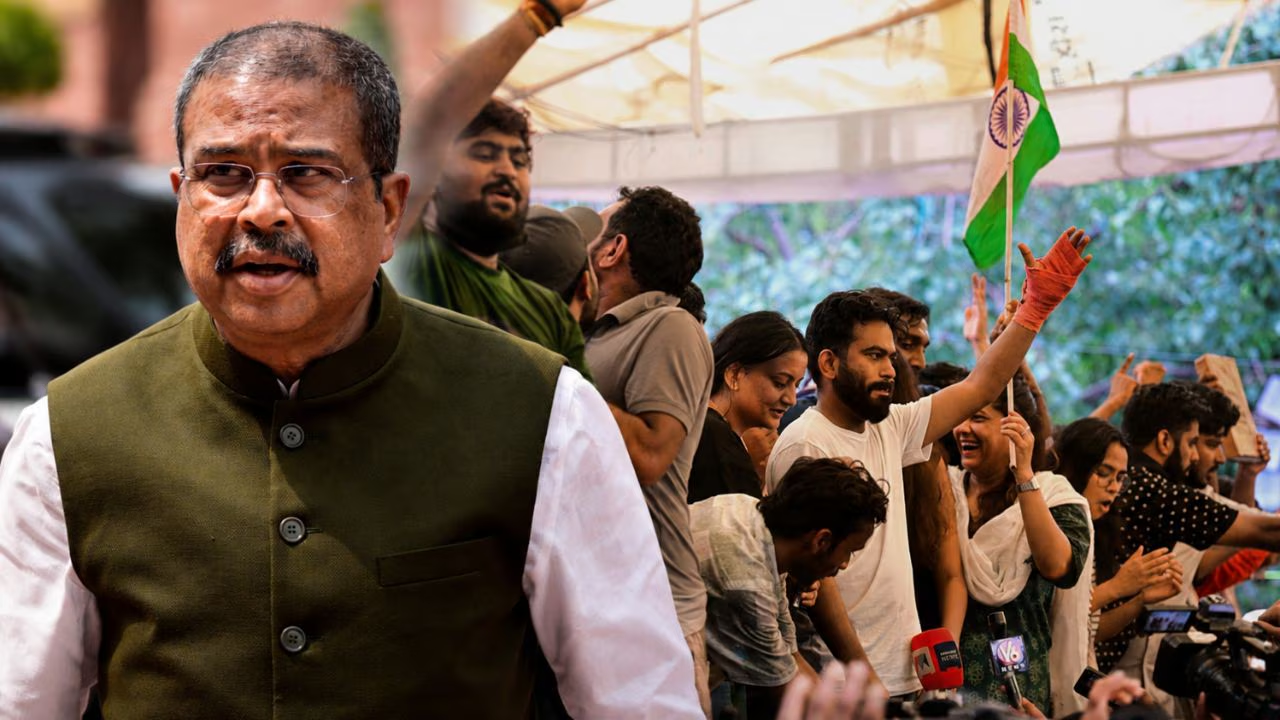
The recent resignation of Dharmendra Pradhan in the recent political development has cast the focus on Parliament, where the government will take its next step.
Published: July 26, 2026, 2:30 PM IST
Share Article
https://www.india.com/news/india/dharmendra-pradhan-resigns-what-happens-next-in-parliament-monsoon-session-opposition-corner-govt-on-police-brutality-on-students-seek-pms-apology-rahul-gandhi-questions-pellet-guns-use-cjp-protest-8484431/
The resignation of Dharmendra Pradhan as Union Education Minister has emerged as a defining moment in the nationwide movement over alleged examination paper leaks. After weeks of protests, political pressure and growing public outrage, his exit has been hailed by many demonstrators as a significant milestone in their demand for accountability. Meanwhile, Union Minister Pralhad Joshi on Sunday assumed charge as the Union Education Minister.
Taking to X, Union Minister Pralhad Joshi said, “Today, I assumed charge as the Union Minister for Education. I am grateful to Hon’ble Prime Minister Shri @narendramodi ji for placing his faith in me and entrusting me with this responsibility,” the Minister stated.He further added, “I accept it with humility and a deep sense of duty.”
President Droupadi Murmu accepted the resignation of Dharmendra Pradhan from the Union Council of Ministers. Pradhan’s resignation was accepted with immediate effect, and Joshi will continue to hold his existing portfolio along with the Education Ministry charge. An official release by Rashtrapati Bhavan read, “The President of India, as advised by the Prime Minister, has accepted the resignation of Shri Dharmendra Pradhan from the Union Council of Ministers, with immediate effect, under clause (2) of Article 75 of the Constitution of India. Further, as advised by the Prime Minister, the President has directed that Shri Pralhad Joshi, Cabinet Minister, be assigned the charge of the Ministry of Education, in addition to his existing portfolio.”
Today, I assumed charge as the Union Minister for Education.
I am grateful to Hon’ble Prime Minister Shri @narendramodi ji for placing his faith in me and entrusting me with this responsibility. I accept it with humility and a deep sense of duty.
ಇಂದು ಭಾರತ ಸರ್ಕಾರದ ಕೇಂದ್ರ ಶಿಕ್ಷಣ… pic.twitter.com/Ge2ulvf3L8
— Pralhad Joshi (@JoshiPralhad) July 26, 2026
The recent resignation of Dharmendra Pradhan in the recent political development has cast the focus on Parliament, where the government will take its next step. The resignation comes at a critical time when the Monsoon Session has begun, and many important bills and policy matters need to be discussed. The question that arises is whether the government will continue with its legislative plan as before or whether this new development will continue to affect the course of Parliament, leading to more upheavals and raucous discussions. Political watchers are observing the moves of the Opposition parties as parties are expected to raise fresh questions over alleged examination paper leaks, accountability, and the government’s handling of the controversy. The Centre’s actions in the days to come can have a large impact on what happens in the Monsoon Session going forward.
The Parliament is expected to return to its normal functioning tomorrow following the resignation of Dharmendra Pradhan from the role of Education Minister – a demand of students who have been protesting against education system in the country as well as opposition parties, as the government will introduce the Public Examinations (Prevention of Unfair Means) Amendment Bill, 2026, in the Lok Sabha on Monday(July 27)to avoid future incidents of paper leaks during competitive examinations. The Public Examinations (Prevention of Unfair Means) Amendment Bill, 2026, has strong penal provisions to deal with any case of paper leaks. It will be introduced by Science and Technology Minister Jitendra Singh, who along with Union Health Minister JP Nadda held talks with Cockroach Janata Party delegation to find a solution to the protest over the NEET-UG paper leak.
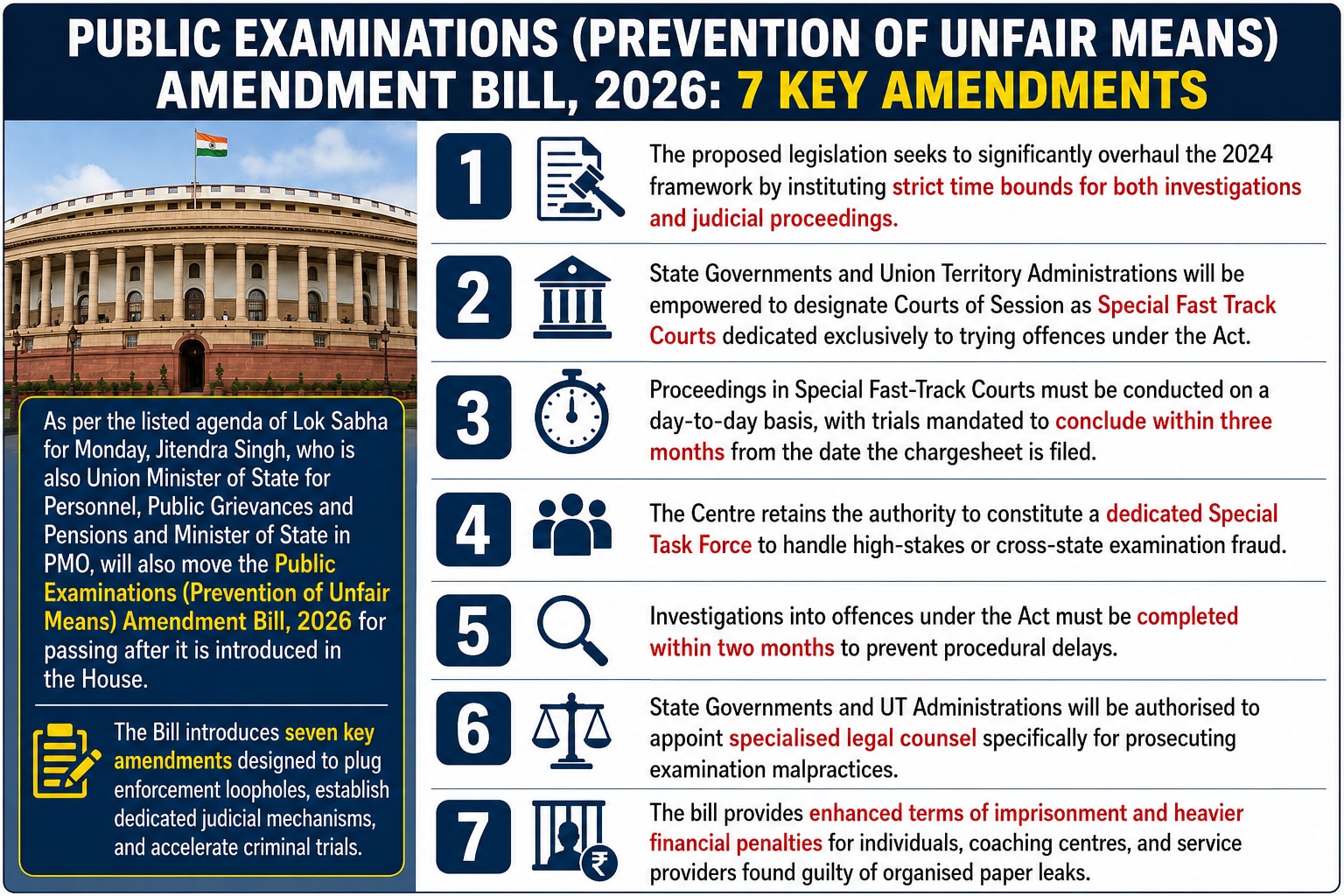
According to the ANI report, the government is also likely to push its legislative agenda in the remaining period of the monsoon session as the first week was almost washed out due to opposition protests. As per the listed agenda of Lok Sabha for Monday, Jitendra Singh, who is also Union Minister of State for Personnel, Public Grievances and Pensions and Minister of State in PMO, will also move the Public Examinations (Prevention of Unfair Means) Amendment Bill, 2026 for passing after it is introduced in the House.
The Bill introduces seven key amendments designed to plug enforcement loopholes, establish dedicated judicial mechanisms, and accelerate criminal trials.
The proposed legislation seeks to significantly overhaul the 2024 framework by instituting strict time bounds for both investigations and judicial proceedings. State Governments and Union Territory Administrations will be empowered to designate Courts of Session as Special Fast Track Courts dedicated exclusively to trying offences under the Act. Proceedings in Special Fast-Track Courts must be conducted on a day-to-day basis, with trials mandated to conclude within three months from the date the chargesheet is filed. The Centre retains the authority to constitute a dedicated Special Task Force to handle high-stakes or cross-state examination fraud. Investigations into offences under the Act must be completed within two months to prevent procedural delays. State Governments and UT Administrations will be authorised to appoint specialised legal counsel specifically for prosecuting examination malpractices. Moreover, the bill provides enhanced terms of imprisonment and heavier financial penalties for individuals, coaching centres, and service providers found guilty of organised paper leaks.
Earlier today, Cockroach Janata Party (CJP) founder Abhijeet Dipke expressed his gratitude to his supporters across the country for backing its 37-day agitation. He stated that their support and trust made the “huge victory of the youth” possible. Sharing a post on X, Dipke said the prolonged agitation had been difficult for the entire team and thanked those who stood by the movement despite criticism and doubts. “It feels really good… finally, at last, I have been able to sleep peacefully and wake up in my bedroom without thinking about what to do next, or what will happen by this evening or not. There is no panic,” he added.
Rahul Gandhi, the leader of the Opposition in the Lok Sabha, continues to slam the central government over police brutality against student demonstrators. On Sunday, Rahul Gandhi sharply questioned Union Home Minister Amit Shah of alleged excessive force used against the demonstrators in the national capital. Coming on the heels of Union Education Minister Dharmendra Pradhan’s resignation, Gandhi’s remarks centred on police action during the July 20 ‘Sansad Chalo’ march led by the Cockroach Janata Party (CJP).
Taking to X, Rahul Gandhi wrote, “Pellet guns, lathis and tear gas were used against students peacefully protesting in Delhi. I met 19-year-old Sahil Lochab. Shot with pellets, he may lose an eye. His “crime”? Demanding an end to paper leaks and a fair future for our students. @AmitShah ji, I have two questions: 1. Did you approve the use of lethal force, including pellet guns, against students? If not, who did? 2. Were the men in plain clothes beating students with lathis police personnel or volunteers? Who authorised their deployment? Desh jawab maang raha hai.”
Pellet guns, lathis and tear gas were used against students peacefully protesting in Delhi.
I met 19-year-old Sahil Lochab. Shot with pellets, he may lose an eye. His “crime”? Demanding an end to paper leaks and a fair future for our students.@AmitShah ji, I have two… https://t.co/861NLmRgNp
— Rahul Gandhi (@RahulGandhi) July 26, 2026