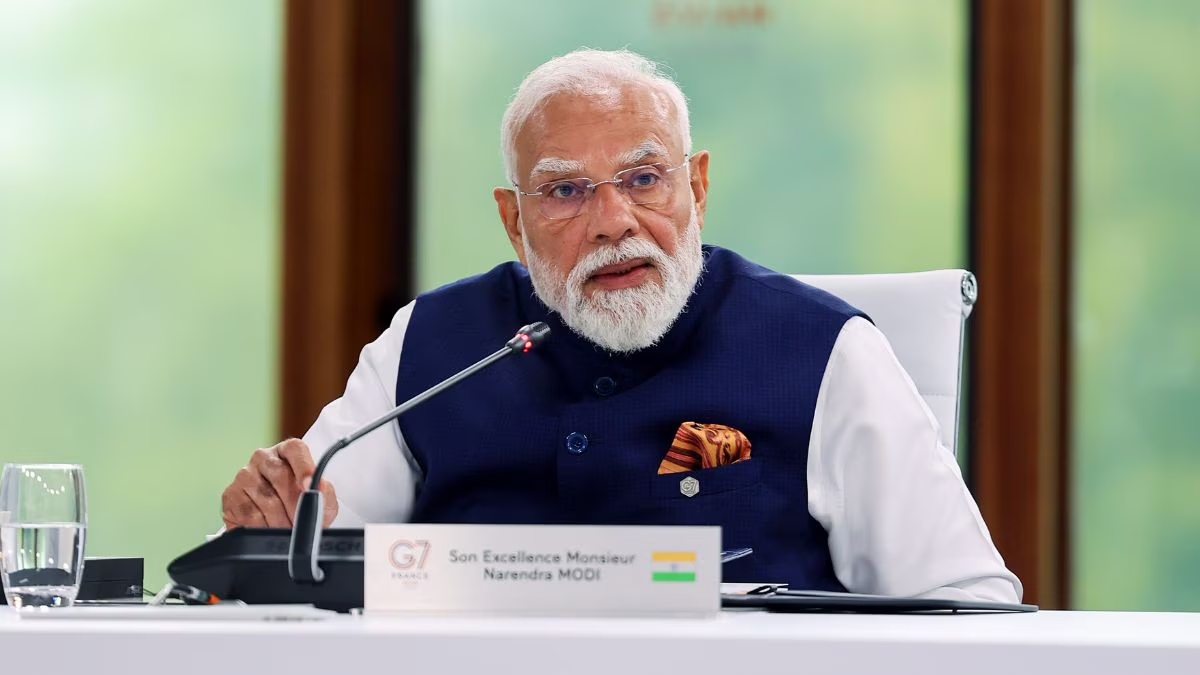
At the G7 Summit in France, Prime Minister Narendra Modi highlighted the importance of maritime security stating that all countries must ensure that maritime routes remain secure and that seafarers can perform their duties without fear. This comes just a few days after three Indian mariners killed in a US military strike in the Gulf of Oman.
Published: June 17, 2026, 1:09 AM IST
Share Article
https://www.india.com/news/world/pm-modi-raises-maritime-security-concern-at-g7-summit-amid-diplomatic-tensions-over-us-strike-says-sea-lanes-must-remain-safe-france-8448596/
Prime Minister Narendra Modi speaks at the Outreach Session on “Forging new Partnerships and rebuilding international solidarity” at the G7 Summit in Evian. ANI
All countries must ensure that maritime routes remain secure and that seafarers can perform their duties without fear, Prime Minister Narendra Modi told a gathering of G7 leaders, including US President Donald Trump, on Tuesday, days after three Indian mariners were killed in a US military strike in the Gulf of Oman.
The prime minister, addressing an outreach session of the G7 summit, said India firmly believes lasting solutions to conflicts can only be found through dialogue, diplomacy and international cooperation. Modi said disruptions to maritime trade in the Strait of Hormuz have harmed the global economy and that many Indian citizens have lost their lives in the conflict.
Modi’s comments on underlining the importance of ensuring the safety of seafarers came against the backdrop of growing anger in India over the killing of the three Indian crew members in a US military attack on a merchant ship off the coast of Oman last week. Modi raised the issue a day ahead of his bilateral talks with the US president.
“We welcome the progress made in peace efforts in West Asia. This conflict has caused loss of life and property in our friendly countries in the region,” Modi said in his address on the session ‘Forging New Partnerships and Rebuilding International Solidarity’. The prime minister said disruptions to maritime trade in the Strait of Hormuz have hit the global economy.
“It is our responsibility to ensure the safety of the seafarers who connect all nations through global maritime trade. We must ensure that maritime routes remain secure and that seafarers can perform their duties without fear,” he said.
The US Central Command said it initiated action to disable the three vessels – Marivex on June 8, Settebello on June 9 and Jalveer on June 11, saying they were trying to violate the US blockade of Iranian ports.
What did PM Modi say in his address?
In his address, Modi, delving into geopolitical upheavals and developments, stressed the need for “trust” among countries. He argued that the most important strategic asset is not minerals, technology, or markets today, but mutual trust.
The prime minister said that in an interconnected world, where energy, food, health, cyber, and economic security are intertwined, building international partnerships was a necessity for the progress and prosperity of humanity.
“Today’s world is more interconnected and interdependent than ever before. A nation’s energy, food, health, and cyber security, as well as its economic prosperity, are not determined solely within its own borders. Mobility, data, capital, and technology all connect us,” he said.
“In such times, the importance of partnerships naturally grows. However, partnerships succeed only when trust lies at their core,” he said.
“The trust that technology and supply chains will be used for the global good, rather than as weapons. The trust that development opportunities will not be limited to just a few countries. The trust that global institutions will be capable of fulfilling the aspirations of all nations,” he said.
Modi also flagged the concerns of the countries of the Global South and said they aspire to be partners in global development.
“Today, the Global South has high expectations of the global community. However, what they seek is not merely support, but partnership. They aspire to be partners in global development, not just beneficiaries,” he said. “We must move beyond the donor-recipient mindset and work as equal partners. We should walk together, side by side. Partnership must be rooted in dignity, not dependency.”
Speaking about India’s inclusive and sustainable growth, Modi elaborated that its mantra is “Sarv Jan Hitaye, Sarv Jan Sukhaye” (welfare and happiness for all). He said this approach had led to appreciable results in fostering financial inclusion, health security, digital identity, technology-led empowerment of people and women-led development.
The Group of 7 (G7) brings together seven of the world’s most advanced economies: Canada, France, Germany, Italy, Japan, the United Kingdom and the United States. The European Union is also a member of the bloc. The G7 serves as the forum of choice for its members to discuss and coordinate action in response to major economic, financial and geopolitical challenges on the global stage.
With inputs from PTI