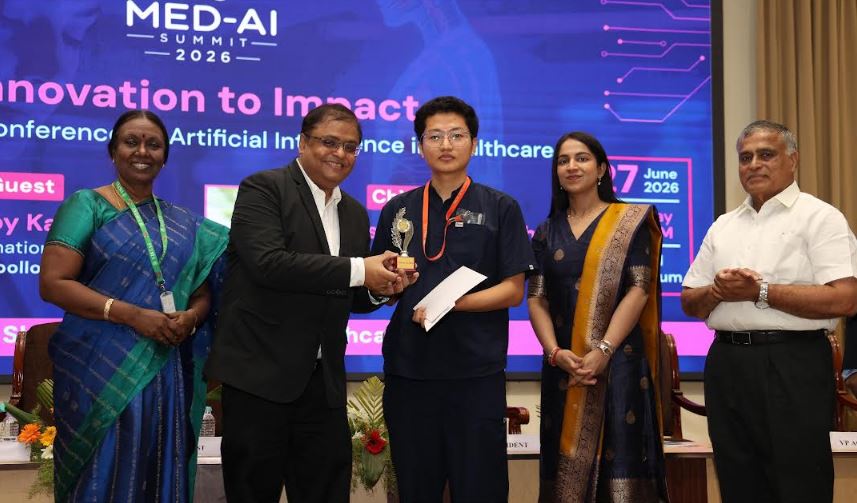
Reinforcing its position as one of India’s emerging leaders in medical education, healthcare innovation, and research, Vels Medical College & Hospital, a constituent institution of Vels Institute of Science, Technology and Advanced Studies (VISTAS), successfully organized MED-AI Summit 2026 – Innovation to Impact, an International Conference on Artificial Intelligence in Healthcare, from 25 to 27 June 2026 at its campus in Tiruvallur, Tamil Nadu.
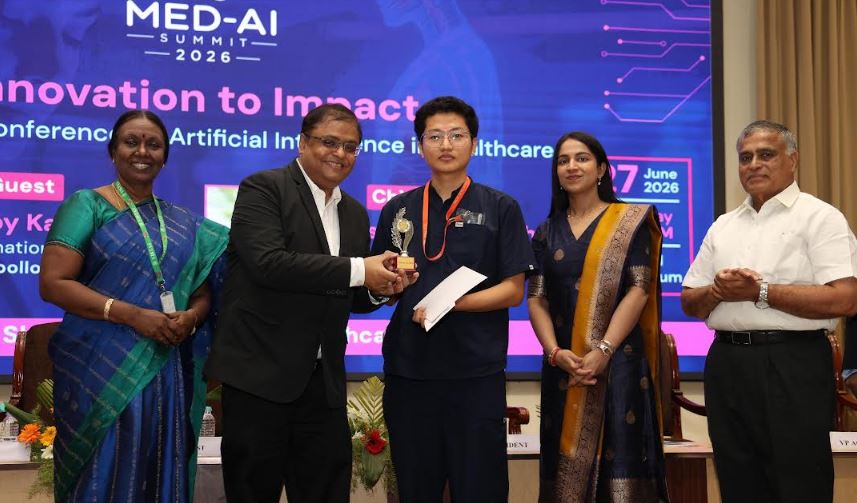 |
Dr. Preethaa Ganesh, inaugurates MED-AI Summit 2026 at VMCH along with Dr. Sujoy Kar
Held under the visionary leadership of Dr. Ishari K. Ganesh, Founder & Chancellor, VISTAS, the three-day international summit brought together leading clinicians, medical researchers, academicians, healthcare professionals, AI experts, technologists, policymakers, and industry leaders from India and abroad to explore how Artificial Intelligence is transforming the future of healthcare.
The conference served as a global knowledge-sharing platform, focusing on AI-powered diagnostics, digital healthcare, predictive analytics, clinical decision support systems, precision medicine, intelligent medical education, biomedical research, and next-gzzeneration healthcare technologies. Through keynote lectures, scientific sessions, panel discussions, workshops, oral presentations, poster sessions, and networking opportunities, participants gained valuable insights into the rapidly evolving landscape of AI-enabled healthcare.
The inaugural ceremony was presided over by Dr. Preethaa Ganesh, Vice President – Vels Group of Institutions, with Dr. Sujoy Kar, Chief Medical Information Officer & Vice President, Apollo Hospitals, serving as the Chief Guest.
Addressing the gathering, Dr. Sujoy Kar, Chief Medical Information Officer & Vice President, Apollo Hospitals, appreciated the visionary initiatives of Dr. Ishari K. Ganesh, Founder & Chancellor, VISTAS, particularly the institution’s commitment to providing free medical treatment to nearly 200 villagers in the surrounding communities through its healthcare outreach programmes.
Emphasizing the future of medicine, Dr. Kar remarked that “Doctors must lead Artificial Intelligence, not be led by it.” He urged young medical professionals to learn both the language of medicine and the language of AI, enabling them to harness technology responsibly for better patient care.
He further encouraged students and faculty to devote more time to active research, innovation, and interdisciplinary collaboration, stating that research will be the driving force behind the next generation of healthcare advancements.
Expressing his enthusiasm for future collaborations, Dr. Kar said, “Apollo Hospitals looks forward to working closely with VELS. Together, we can strengthen research, innovation, and AI-driven healthcare for the benefit of society.”
Distinguished dignitaries present included Dr. S. Asokan, Chief Executive Officer, GEM Hospitals, Chennai; Dr. Kumudha Lingaraj, Dean, Vels Medical College & Hospital; Dr. Prince J. Samuel, Vice Principal (Academics); Dr. Maignana Kumar, Vice Principal (Accreditations); and Dr. Vijayashree R., Professor & Head, Department of Pathology and Organizing Chairperson, MED-AI Summit 2026. The event witnessed enthusiastic participation from senior faculty members, researchers, healthcare professionals, students, and delegates representing premier institutions across the country.
Adding significant international value to the summit were globally acclaimed experts including Dr. Waqar M. Naqvi, Founder & Research Lead, AD Vivum Education & Research, Doha, Qatar, and Dr. Priyah Prathaban, Associate Professor, Faculty of Medicine, AIMST University, Malaysia.
The conference also featured an impressive lineup of distinguished national experts including Dr. T. V. Geetha (Anna University, Chennai), Dr. Kalavathy Moses S. (SIMS Hospital, Chennai), Dr. C. N. Srinivas (Sukraa Software Solutions), Dr. Madhuvanthi Mohan (Rajan Eye Care, Chennai), Dr. S. Asokan (GEM Hospitals), Dr. Sudha Jasmine Rajan (Christian Medical College, Vellore), Dr. D. C. Mathangi (Sri Ramachandra Institute of Higher Education and Research, Chennai), Dr. S. Rajendiran (Sri Devaraj Urs Academy of Higher Education and Research, Kolar), and Mr. Venkata Phanidhar Nelluri, who shared their expertise on AI applications in surgery, pathology, ophthalmology, laboratory medicine, medical education, biomedical research, and critical care.
The summit witnessed exceptional participation throughout all three days. The pre-conference hands-on workshops conducted on 25 June 2026 attracted 333 participants across seven clinical departments, highlighting the growing interest in AI-driven clinical learning.
The scientific conference held on 26 and 27 June 2026 recorded 447 delegates each day, comprising faculty members, undergraduate and postgraduate students, clinicians, researchers, healthcare professionals, and industry representatives from leading medical colleges, hospitals, universities, and research institutions across India.
MED-AI Summit 2026 featured seven pre-conference workshops, nine scientific sessions, the prestigious Velan Oration Lecture, oral and poster presentations, award-winning research paper sessions, panel discussions, and collaborative networking opportunities, making it one of the most comprehensive AI-focused healthcare conferences hosted by a medical institution in the region.
During the conference, speakers emphasized that Artificial Intelligence is rapidly reshaping modern medicine by improving diagnostic accuracy, strengthening clinical decision-making, enhancing patient outcomes, accelerating medical research, and transforming healthcare delivery. They also underscored the importance of ethical, responsible, and evidence-based integration of AI technologies to complement clinical expertise while maintaining patient safety and trust.
Speaking about the significance of the summit, the organizers reiterated that Vels Medical College & Hospital remains committed to creating an ecosystem that promotes innovation, interdisciplinary research, technology-enabled medical education, and collaborative healthcare solutions. The institution continues to invest in academic excellence while preparing future healthcare professionals to lead in the era of digital medicine and Artificial Intelligence.
MED-AI Summit 2026 stands as yet another milestone in the journey of Vels Medical College & Hospital towards becoming a nationally and internationally recognized centre for medical education, clinical excellence, healthcare innovation, and cutting-edge research. By bringing together globally renowned experts, leading academicians, clinicians, researchers, students, and industry pioneers, the summit has strengthened Vels Medical College & Hospital’s reputation as a destination for transformative medical learning and AI-driven healthcare innovation, paving the way for future collaborations that will shape the next generation of intelligent heaalthcare.
For more details please visit : velsmedicalcollege.com.