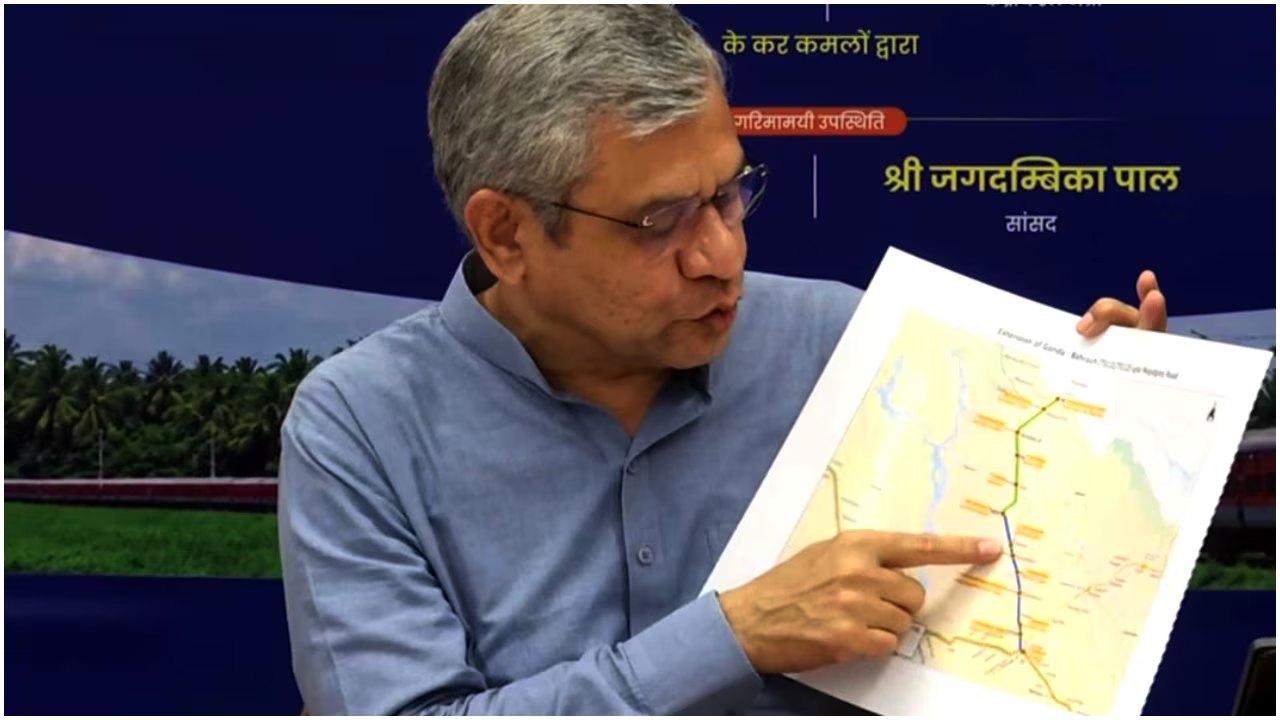
The proposed bullet train project will reduce travel times from Delhi to Lucknow to two hours and to Patna to 4.5 hours, Railway Minister Ashwini Vaishnaw said on Monday.
Share Article
https://www.india.com/news/india/delhi-lucknow-in-2-12-hours-delhi-patna-in-4-5-railway-minister-outlines-bullet-train-plans-to-reduce-travel-time-between-up-bihar-cities-8513894/
Delhi-Lucknow in 2.12 hours, Delhi-Patna in 4.5: Railway Minister outlines bullet train plans to reduce travel time between UP, Bihar cities | Image: ANI
Delhi-Lucknow in 2.12 hours, Delhi-Patna in 4.5 hours: Passengers will be able to travel from Delhi to Lucknow in just 2.12 hours and from Delhi to Patna in just 4.5 hours in the coming yearsRailway Minister Ashwini Vaishnaw on Monday said that the travel time to major cities in Uttar Pradesh and Bihar from Delhi is going to be reduced drastically with the bullet train project.
While addressing the gathering during the inauguration of newly converted and electrified broad-gauge rail line on the Nepalganj Road-Nanpara-Bahraich section, Vaishnaw informed that the proposed bullet train corridor would include major cities in UP and Bihar, such as Agra, Kanpur, Lucknow, Varanasi and Patna and connect them to Delhi.
The Railway Minister emphasised that the proposed project will drastically reduce the time between capital city and major cities of UP and Bihar, saving several hours of journey.
The minister said that under the project, the estimated travel time between Delhi and Agra (200 km) will be 58 minutes.
Time to reach Kanpur from Delhi (455 km) will be 1 hour 50 minutes; the route to Lucknow (495 km) will be 2 hours 12 minutes and it will take three hours to reach Prayagraj (750 km) from the national capital.
The proposed bullet train will take about 3 hours 33 minutes to reach Varanasi from Delhi (945 km) and 4.5 hours (1,170 km) to reach Patna.
“If the project materialises, it will be the next phase bullet train corridor in the country after the Mumbai-Ahmedabad corridor and the first to connect the National Capital with many cities of Uttar Pradesh and Bihar,” Vaisnaw said.
The proposed corridor will not only provide a huge relief to lakhs of daily passengers but is also expected to boost tourism, business and economic activity across the Delhi-UP-Bihar belt, especially in religious tourism hubs like Agra, Prayagraj, Varanasi, Gorakhpur and Patna.
Currently, the highest design speed in the Indian railway network is around 180 kmph, achieved by semi-high-speed services such as Vande BharatAgainst this, the Mumbai-Ahmedabad High Speed Rail (MAHSR) Project has a design speed of 350 kmph and an operational speed of 320 kmphIt is one of the most extensive rail infrastructure programmes undertaken in India, and will connect Mumbai and Ahmedabad in about 1 hour 58 minutes.
The first high-speed rail service in the country is expected to commence in August 2027 and the first section to be opened will be from Surat to Vapi.
Vaishnaw said that India will train 1,00,000 semiconductor engineers under Phase 2 of its chip program in order to encourage and expand local talentHe said that through the program, the government will build a complete domestic ecosystem.
Vaishnav, while speaking at Semicon 2.0, stated that the move will aims not only at large-scale semiconductor manufacturing but also on developing talent, chip design, equipment, and materials.
(wiht ANI inputs)