From mass entertainer to a powerful public figure, Vijay’s evolution reflects how cinema, fandom, and modern communication reshape leadership narratives in Tamil Nadu’s changing political landscape.
Share Article
https://www.india.com/entertainment/how-thalapathy-vijay-completed-the-political-screenplay-that-rajinikanth-and-kamal-haasan-couldnt-finish-naalaiya-theerpu-poove-unakkaga-ghilli-thirupaachi-padayappa-baasha-thalapathi-nayakan-8453893/
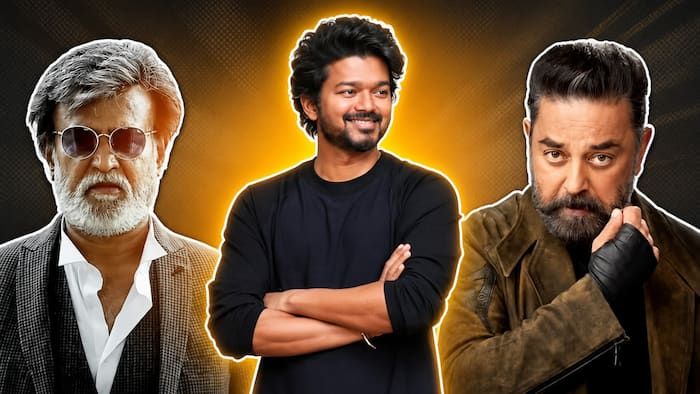
Rajinikanth, Thalapathy Vijay and Kamal Haasan
Thalapathy Vijay’s journey in Tamil cinema has grown step by step from child artist to one of most influential public figures in state of Tamil Nadu. His films built not just entertainment value but also a strong emotional bond with audiences across generations. On his 52nd birthday, Tamil Nadu Chief Minister C. Joseph Vijay is widely seen as someone whose career reflects a shift from pure stardom to wider social influence and political identity. His rise is not sudden but shaped through consistent success, strong fan culture, and films that slowly expanded his public image beyond cinema.
How did Vijay’s film journey shape his mass identity?
Vijay’s early career focused on romantic and family entertainers like Naalaiya Theerpu and Poove Unakkaga, which helped him build a steady fan base. He then transitioned into youth-centric hits such as Thulladha Manamum Thullum, Kushi, and Priyamaanavale, which strengthened his emotional connection with younger audiences. His real mass transformation came with action entertainers like Ghilli, Thirupaachi, Sivakasi, and Pokkiri, where he fully emerged as a crowd-pulling superstar. These films established him as a consistent box office force and made him a household name across Tamil Nadu.
Why is the comparison with Rajinikanth and Kamal Haasan always made?
For decades, Thalaivar Rajinikanth and Ulaganayagan Kamal Haasan represented the strongest examples of cinema-to-politics transitions in Tamil Nadu. Rajinikanth built an unmatched mass appeal through films like Padayappa, Baasha, Thalapathi, Sivaji: The Boss, and Enthiran, while Kamal Haasan delivered critically acclaimed and experimental cinema like Nayakan, Aalavandhan, Indian, Dasavatharam, Vishwaroopam, and Vikram, later launching his political party, Makkal Needhi Maiam, on February 21, 2018.
Rajinikanth also formally announced his entry into politics in December 2020, with plans to launch a political party ahead of the 2021 Tamil Nadu elections. However, citing health concerns, he later decided to withdraw from active political entry in 2021, bringing an end to what was widely seen as one of the most anticipated political transitions in Tamil Nadu cinema history. Both created huge expectations around political entry, but their journeys followed different directions without full execution of long-term governing leadership. This left space for a new kind of political screenplay in the modern era.
How did Vijay build a structured rise beyond cinema?
Joseph Vijay followed a gradual and calculated path rather than a sudden political entry. After becoming a mass star through films like AR Murugadoss’ Thuppakki, Kaththi, and Atlee Kumar’s Theri, Mersal and Bigil, he further strengthened his position with socially themed blockbusters such as Sarkar, Master, Beast, Leo, and The Greatest of All Time (GOAT).
These films not only reinforced his box office dominance but also subtly connected with social and political themes that shaped his public identity. Parallelly, his fan welfare movement Vijay Makkal Iyakkam became a strong grassroots base, which later evolved into Tamilaga Vettri Kazhagam, marking his structured political entry.
How did youth and digital culture amplify his stardom?
Vijay’s biggest strength has always been his connection with youth. From Ghilli and Pokkiri to Master and Leo, his films created celebration culture around theatres. Songs, dialogues, and dance styles became part of everyday youth expression. In the digital era, this fan energy multiplied. Trailer launches, audio events, and film updates trend instantly online. Unlike earlier generations of stars, Vijay’s popularity grew alongside social media platforms, making him one of the most visible modern-day superstars for his beloved akkas, nanbaas and thambi’s.
Why is he called a “minimum guarantee” star?
Even when films receive mixed reviews, Vijay’s box office performance remains strong. Movies like Beast and Varisu still opened with massive collections, proving his consistent pull at the ticket window not just in domestic arena but citing his stronghold in overseas as well. This created the “minimum guarantee” reputation, where distributors trust his films for strong opening-day numbers. It also established him as one of the most financially reliable stars in Tamil cinema’s modern commercial landscape.
The political screenplay that Rajinikanth and Kamal Haasan couldn’t finish
Over time, Vijay’s public image expanded beyond cinema. His speeches, film themes, and public interactions started reflecting broader social concerns. Without aggressive positioning, he built an image of a responsible public figure who communicates carefully but effectively. His structured organisation, combined with long-term fan engagement, helped shape his transition into politics in a gradual and stable manner.
In many ways, this evolution reflects a larger political screenplay that Tamil cinema stalwarts Rajinikanth and Kamal Haasan had long been associated with but could not fully complete, as their journeys inspired massive expectations of cinema translating into long-term political leadership but ultimately followed different paths before reaching full governing execution, making Vijay’s rise widely seen as the modern continuation of that unfinished narrative shaped by a new era of media youth influence and structured grassroots organisation.