SpaceX vs The World: Elon Musks Race to Build the First Lunar City
Musk is saying this Moon project can be finished in less than ten years. Compare this with Mars – building a city there would take more than twenty years.
Published: February 9, 2026 8:27 PM IST
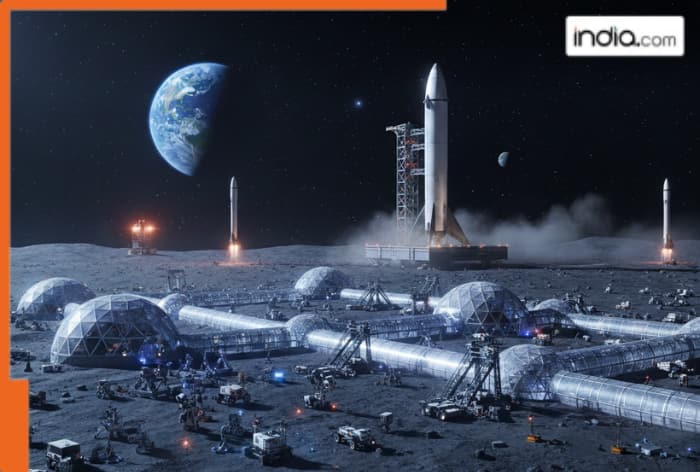
Representational AI image
Elon Musk is now saying something that many of us never expected to hear. For years, he kept talking about Mars, Mars, Mars – making it sound like Mars was the ultimate destination for humanity’s future. But now, he has suddenly changed his mind and decided that Moon is the priority first, then Mars later. This shift in thinking is quite interesting, and once you understand the full story, you will see that it is not just about being smart – it is also about following the money.
Let me explain what is really happening here. SpaceX, his space company, is planning to build what he calls a “self-growing city” on the Moon. What does this self-growing city mean? Simply put, it is a settlement that grows and expands all by itself over time without needing everything to be sent from Earth again and again. Instead of constantly sending supplies from our planet, robots and 3D printing machines will use the Moon’s own materials to build houses, roads, power systems, and everything else needed for living there. It is like planting a seed that grows into a big tree without you having to feed it every single day.
But here is the real reason behind this sudden shift – NASA has given SpaceX billions and billions of dollars. This money comes through something called the Starship HLS contract. HLS stands for Human Landing System, which simply means the spacecraft and technology needed to safely land human astronauts on the Moon’s surface. Think of it like this – if you want to bring people to the Moon, you need a special vehicle that can do that job. That vehicle must be designed, built, tested, and perfected. NASA is basically saying to SpaceX, “Build us this landing system, and we will pay you billions of dollars for it.”
When a government agency gives you billions of dollars to do something, that becomes your priority. It is like getting paid handsomely to do a job – suddenly, that job moves to the top of your to-do list. So when Elon talks about Moon being the smart choice, he is also talking about the smart choice that NASA is literally paying him to make.
Now, does this make the strategy wrong or less noble? Not at all. In fact, it makes it more realistic. Even the biggest dreamers in the world cannot ignore billions of dollars staring at them. Elon wants to make humanity a multi-planetary species, and NASA is saying, “Great idea, we will fund the Moon part first.” It is a perfect marriage of ambition and funding.
Here is where the numbers tell the real story. Think about how easy it is to reach the Moon compared to Mars. A spacecraft can be sent to the Moon every ten days, and the journey takes only about two days. That means you can send missions very frequently and they arrive quickly. But Mars? It is a completely different ball game. Missions to Mars can happen only once every twenty-six months because the planets need to be in the right position for the journey to work. And even when conditions are perfect, the trip to Mars takes around six months. So you are looking at six months in space just to get there, compared to two days for the Moon. You can see why NASA would rather invest in the closer target first. The Moon makes logical sense, and it makes financial sense too.
Musk is saying this Moon project can be finished in less than ten years. Compare this with Mars – building a city there would take more than twenty years. Why this huge difference? Because of these exact timelines we just discussed. The Moon is nearby and reachable often. Mars is far away and reachable rarely. But the Moon is much closer and easier to manage.
Some people might think that Elon is abandoning Mars completely. That is not true. He has made it clear that SpaceX will continue working on Mars missions too. The company still plans to start building a settlement on Mars within five to seven years. However, the priority has changed. Moon comes first because NASA is paying for it through the HLS contract, and Mars comes later. This is smart business.
Why is Moon getting more importance? Practical reasons, yes – faster progress and more frequent launches. But also, NASA’s billions. China is pushing hard to send astronauts to the Moon, and America cannot fall behind. The last time humans walked on the Moon was in 1972, and that is over fifty years ago. Both America and China see the Moon as the key to controlling space in the future. NASA knows this, which is why they are investing heavily in getting Americans back there quickly.
Think of it this way – if you want to build a strong house, you first lay a strong foundation. Moon is the foundation. Once we have a thriving city there, reaching Mars will become much easier. We will have learned all the lessons and developed all the technology.
Elon’s focus shows something important – even the biggest dreamers understand that visions need funding to become reality. The NASA contract is not a distraction from his Mars dreams. It is the pathway to making those dreams actually happen. Sometimes, following the money and following your dreams point in the same direction.















Leave a Reply