

HAL is challenging this monopoly with a strategy that blends indigenous innovation with smart global partnerships.

Published: January 23, 2026 6:55 PM IST
Something exciting is brewing in Indian aviation, and it deserves our attention. Hindustan Aeronautics Limited (HAL), the company known for building fighter jets for our armed forces, is now stepping into the civilian market in a massive way. From January 28-31, 2026, at the Wings India exhibition in Hyderabad, HAL will showcase three aircraft that could change how ordinary Indians fly. This isn’t just another trade show—it’s a bold statement about where our country is headed.
For decades, we’ve watched foreign planes dominate our skies. Whether it’s a flight to Guwahati or a quick hop to Coimbatore, chances are you are sitting in an Airbus or Boeing. HAL is challenging this monopoly with a strategy that blends indigenous innovation with smart global partnerships. The Showstopper: The ‘Indian’ Super Jet The centrepiece of the event is the Super Jet 100 (SJ-100). While originally a Russian design (the Sukhoi Superjet), this project marks a historic shift. In late 2025, HAL signed a landmark Memorandum of Understanding (MoU) with Russia’s United Aircraft Corporation (UAC) to manufacture this regional jet right here in India.Add India.com as a Preferred Source
This is a 100-seater aircraft designed for 2-4 hour journeys—perfect for connecting cities like Delhi-Jaipur or Mumbai-Goa. The version debuting at Hyderabad is special: it is the “Russified” model, stripped of Western components and powered by new PD-8 engines, sporting a livery inspired by the Indian flag. For India, this isn’t just about assembly; it’s about mastering the entire production line of a commercial jet, creating thousands of high-tech jobs, and ensuring we aren’t held hostage by foreign supply chains.
The Workhorse: Hindustan-228
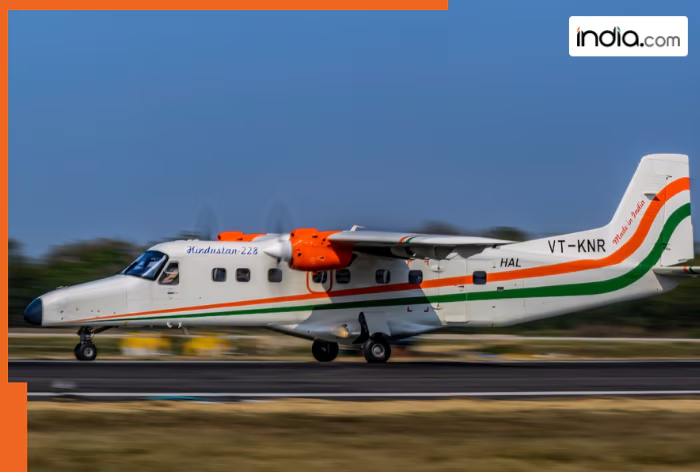
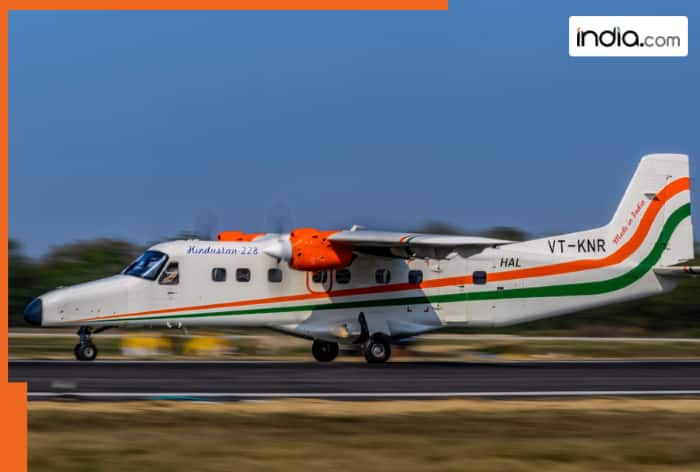
While the jet is the future, the Hindustan-228 is the reality available today. This is the civilian version of the Dornier-228, a rugged turboprop HAL has manufactured under license for the military since 1983.
The facts here are impressive. The 19-seater aircraft received its Type Certification from the DGCA in May 2022. It didn’t just stay on paper—Alliance Air launched the first commercial flight on April 12, 2022, connecting Dibrugarh to Pasighat. This was a historic moment: the first time an Indian airline flew a commercially produced Indian-made plane on a scheduled route.
This plane is built for the “real” India—short runways, island chains like the Andamans, and remote mountain towns in the Northeast where big jets simply cannot land. It is the backbone of the government’s UDAN (Ude Desh ka Aam Naagrik) scheme, taking aviation to the grassroots.
The Lifesaver: Dhruv New Generation (Civil)
Then there is the helicopter that just made history. On December 30, 2025, the civil version of the Dhruv Advanced Light Helicopter (ALH) took its maiden flight.
Known as the “Dhruv New Generation (NG),” this isn’t just a repainted military chopper. It is fitted with powerful, DGCA-certified Shakti 1H1C engines and a glass cockpit designed for civilian safety standards. With a range of over 600 km and seating for 12-14 people, it is positioned as the ultimate tool for disaster relief, emergency medical services (EMS), and VIP transport. In a country where road access can be slow or non-existent, this machine is a literal lifesaver.
A Test of Trust
Dr. D.K. Sunil, HAL’s Chairman, has framed this as a move toward self-reliance. But the real test lies with the passengers. Will Indian airlines buy them? Will passengers feel safe? The Dornier has 40 years of military service proving its toughness. The Super Jet brings modern comfort.
Wings India 2026 is the testing ground. If these aircraft succeed, we aren’t just buying tickets anymore; we are buying into a vision where the plane you board to go home was built by hands that call the same country home.
Source link










Leave a Reply