Baoting Establishes World’s First County-Level “Living Laboratory,” Developing 1.5°C Proactive Health StandardsBAOTING, China, Feb. 1, 2026 /PRNewswire/ — Breaking with decades of capital-centric global health diplomacy, the World Health Organization (WHO) has, for the first time, brought its flagship climate-health conference to the county level, selecting a tropical county in southern China to test scalable solutions for the Global South.
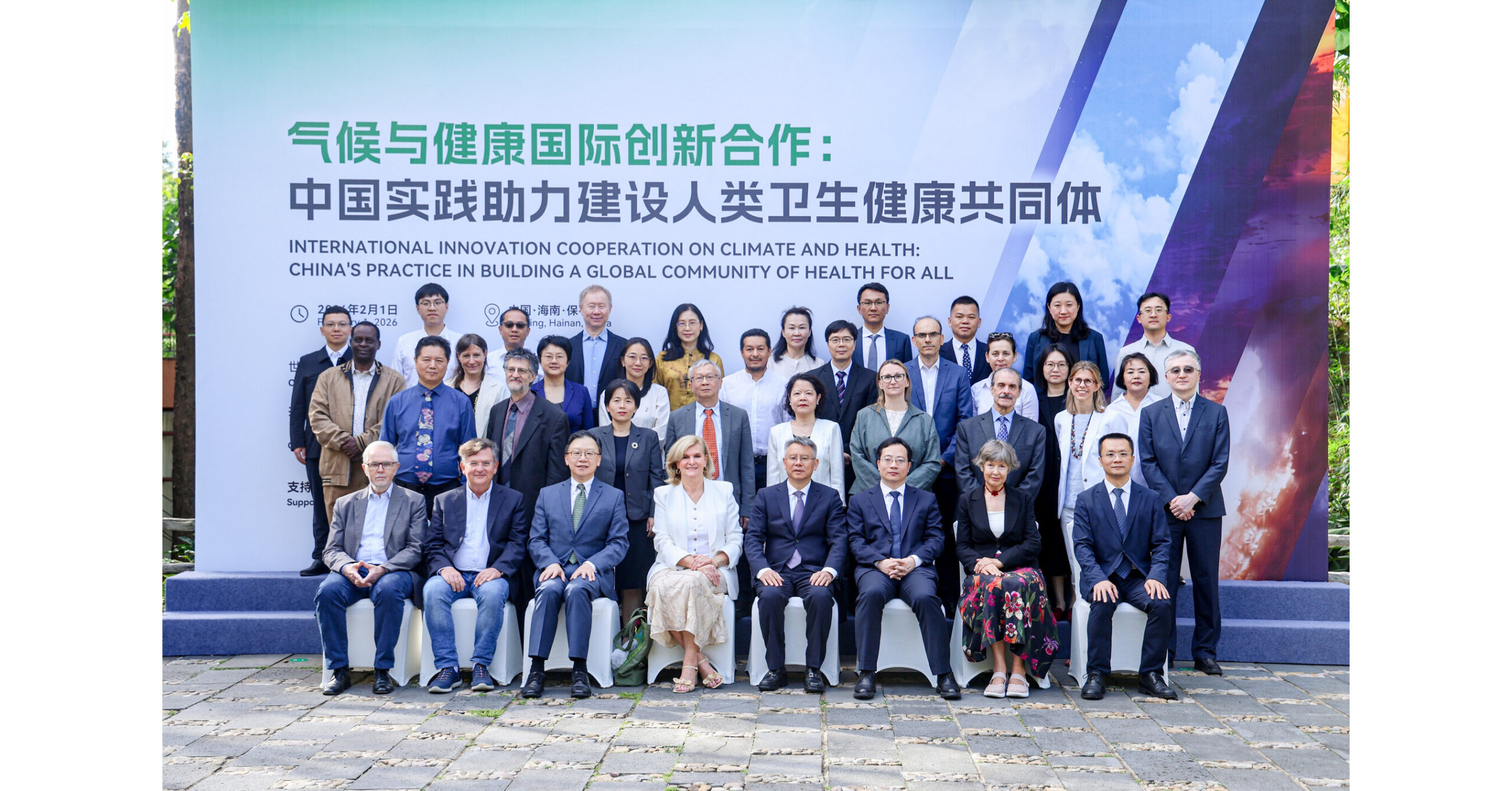
Group Photo at the Launch of the World’s First County-Level Climate-Health Living Laboratory (Baoting, 2026)
Liu Pingzhi, Member of the Hainan Provincial Government Party Leadership Group; Dr. Maria Neira, Former Director of the WHO Department of Environment, Climate Change and Health; Dr. Rüdiger Krech, Acting Director of the WHO Department of Environment, Climate, One Health and Migration; and Zhu Jiang, Party Secretary of the Baoting County Committee
Prof. Fan Wenfei (Foreign Member, Chinese Academy of Sciences), Prof. Zhang Boli (Academician, Chinese Academy of Engineering), Prof. Francesco Forastiere (Imperial College London), Prof. Ren Minghui (Director, WHO Collaborating Centre for Universal Health Coverage; Dean, Peking University Institute for Global Health), Prof. Lidia Morawska (Fellow, Australian Academy of Science), Prof. Wang Qinqin (CTO, Chinese Society for Urban Studies), Prof. Huang Wei (Director, Institute of Environmental Medicine, Peking University), Dr. Pierpaolo Mudu (Senior Technical Officer, WHO Air Quality, Energy and Health Unit), Prof. Michelle Turner (Barcelona Institute for Global Health), Dr. Joseph Spadaro (WHO Environmental Health Policy Advisor), Cai Yaoze (County Mayor, Baoting Li and Miao Autonomous County), and Dr. James Mwitari (Senior Researcher, Kenya Medical Research Institute)
Prof. Fan Wenfei (Foreign Member, Chinese Academy of Sciences), Prof. Zhang Boli (Academician, Chinese Academy of Engineering), Prof. Francesco Forastiere (Imperial College London), Prof. Ren Minghui (Director, WHO Collaborating Centre for Universal Health Coverage; Dean, Peking University Institute for Global Health), Prof. Lidia Morawska (Fellow, Australian Academy of Science), Prof. Wang Qinqin (CTO, Chinese Society for Urban Studies), Prof. Huang Wei (Director, Institute of Environmental Medicine, Peking University), Dr. Pierpaolo Mudu (Senior Technical Officer, WHO Air Quality, Energy and Health Unit), Prof. Michelle Turner (Barcelona Institute for Global Health), Dr. Joseph Spadaro (WHO Environmental Health Policy Advisor), Cai Yaoze (County Mayor, Baoting Li and Miao Autonomous County), and Dr. James Mwitari (Senior Researcher, Kenya Medical Research Institute)
The International Conference on Climate and Health Innovation and Cooperation, concluded today in Baoting Li and Miao Autonomous County, marks a decisive shift from policy advocacy to implementation. The conference was organized by WHO and co-hosted by People’s Government of Baoting Li and Miao Autonomous County, Peking University Institute for Global Health, and Ningyuan Institute of Climate and Sustainable Development (Hainan), with academic support provided by Peking University Institute of Environmental Medicine. By situating the meeting in a climate-vulnerable subtropical county—an island ecosystem facing biodiversity pressures and emerging-economy constraints—the WHO signals clearly: effective climate-health governance must be validated in “micro-laboratories” capable of replication in analogous contexts worldwide.
From High-Level Consensus to Ground-Level Validation
The conference convened international partners from UN agencies, academia, and local governments across 14 countries in the Asia-Pacific, Africa, Europe, and the United States, including Dr. Rüdiger Krech, Acting Director of the WHO Department of Environment, Climate Change and Health, and Dr. Maria Neira, former Director of the same department. The central question: can international stakeholders move beyond written commitments to collaboratively create standardized tools at the local level that are both scientifically rigorous and financially viable?
Baoting—a mountainous tropical county in central Hainan Island—provided the validation case. Its convergence of marine climate vulnerability, rich biodiversity, and emerging-economy characteristics offered a real-world testing ground for validating the WHO’s “Best Buys”—a catalog of low-cost interventions with high climate-health co-benefits.
Local Governments Position the County as a Global Node
In his keynote address, Liu Pingzhi, Member of the Hainan Provincial Government Party Leadership Group and Full-time Deputy Director of the Provincial Major Project Leading Group, called for pragmatic cooperation to drive the convergence of low-carbon technologies, artificial intelligence, and public health services in Baoting and across Hainan, creating replicable and scalable experiences.
Zhu Jiang, Party Secretary of the Baoting Li and Miao Autonomous County Committee, detailed the county’s evolution as an international cooperation zone and its strategic trajectory as a testing ground for climate-resilient health systems. The presence of these high-ranking local officials highlighted a deliberate institutional choice: embedding global health governance within subnational administrative units that directly bear the impact of climate change.
Dr. Krech called for strengthened global knowledge-sharing and resource mobilization to implement WHO priority agendas, affirming that the Baoting pilot demonstrates the innovative potential of county-level units in developing countries within global health governance. Dr. Neira reinforced this strategic pivot, emphasizing the critical pathway from “climate commitments to local action,” and expressing expectation that the Baoting project will become an international model for multi-sectoral collaboration—signaling WHO’s initiative to shift the center of gravity for climate-health implementation downward to the grassroots of administrative structures.
Interdisciplinary Breakthrough: Standardizing Local Action
The conference produced concrete frameworks aimed at executable, transferable outcomes:
Modernization of Traditional Medicine:Prof. Zhang Boli, Academician of the Chinese Academy of Engineering and Honorary President of Tianjin University of Traditional Chinese Medicine, proposed that the holistic philosophy of “correspondence between heaven and human” in Traditional Chinese Medicine (TCM) provides a sustainable philosophical foundation for climate-resilient healthy cities. TCM resources can be transformed into “proactive health” services and industries, integrating preventive wisdom comprehensively into global climate adaptation knowledge systems.
1.5°C Proactive Health System:Prof. Ren Minghui of Peking University proposed a system targeting “climate-resilient cities” through four pathways: digital empowerment, integrated prevention-treatment-recovery-care, ecological-health synergy, and health industry development. By linking government, enterprises, communities, and individuals to form a multi-stakeholder ecosystem, the Hainan Baoting pilot aims to develop measurable, scalable toolkits for proactive health-resilient cities.
Environmental Health Benchmarks:Prof. Francesco Forastiere of the Environmental Health Research Group at Imperial College London emphasized that environmental health interventions should establish efficient pathways from scientific evidence to policy impact, achieving synergistic improvements in health and social benefits.
Air Quality as Resilience Nexus:Prof. Lidia Morawska, Fellow of the Australian Academy of Science at Queensland University of Technology, proposed utilizing low-cost sensors and AI systems to achieve synergistic optimization of indoor air quality, energy consumption, and comfort in buildings, recommending the establishment of demonstration projects in Baoting to drive global standard-setting.
AI Empowerment:Prof. Fan Wenfei, Foreign Member of the Chinese Academy of Sciences and Chief Scientist at Shenzhen Institute of Computing Sciences, demonstrated full-stack AI applications of the “Diaoyucheng Data Analysis System” in public health, stating that “application effectiveness is the sole criterion for testing AI pathways,” and advocating for algorithmic diversification to avoid over-reliance on single paradigms.
1.5°C Building Standards:Prof. Wang Qingqin, Chief Technical Officer of the Chinese Society for Urban Studies, proposed that healthy buildings represent the core advanced direction for the green building industry, and that Baoting’s practice will contribute to constructing 1.5°C standards adapted to marine and island regions.
Health Indicator Integration:Prof. Huang Wei, Director of the Institute of Environmental Medicine at Peking University, participated in formulating the 1.5°C Proactive Health Indicator System, providing an epidemiological framework for quantifying climate-health co-benefits at the county level and ensuring scientific rigor in vulnerability assessments for tropical developing regions.
Baoting Action Matrix: From Concept to Institutionalization
The release of the Baoting Action Matrix (2026–2028) marks the transition of global climate-health cooperation from the advocacy phase to institutionalized implementation:
Standards Level: Drafting the 1.5°C Proactive Health Indicator System, with an international steering committee composed of experts from multiple countries, promoting Baoting practices as “open-source code” replicable by cities in the Global South;
Research Level: Initiating an international scientific cooperation plan to establish a county-level climate-health vulnerability monitoring network covering tropical and subtropical regions, releasing the annual Global County Climate Health Resilience Index;
Practice Level: Deploying and validating WHO “Best Buys” intervention schemes in Baoting as a real-world scenario.
Bridging the Implementation Gap
In closed-door workshops, experts advanced specific standardization pathways, including methodology for the WHO “Best Buys” toolkit and the framework for the 1.5°C Proactive Health Indicator System. Participants also reached preliminary consensus on county-level climate-health finance standards, leveraging Hainan Free Trade Port cross-border capital flow facilitation policies to design climate-health project templates readable by investment banks.
Strategic Significance
Against a backdrop of headwinds facing global multilateralism, the Baoting conference presents a counter-narrative: effective global public goods can originate from county-level innovation. By validating climate-health governance in a vulnerable county representative of the Global South, the WHO and Chinese partners have created a replicable template for the 1.5°C climate resilience agenda.
The consensus and action plan formed at the Baoting conference are expected to provide innovative cooperation paradigms for cities in the Global South and accelerate the transition from vision to reality in building a global community of health for all.
Photo – https://mma.prnewswire.com/media/2874191/image_1.jpg Photo – https://mma.prnewswire.com/media/2874192/image_2.jpg Photo – https://mma.prnewswire.com/media/2874193/image_3.jpg Photo – https://mma.prnewswire.com/media/2874194/image_4.jpg














Leave a Reply