


In a major breakthrough in cardiac care, Lilavati Hospital and Research Centre, Mumbai, has performed India’s first, first-of-its-kind combined cardiac procedure Pulsed Field Ablation (PFA) for Atrial Fibrillation (AF) along with Left Atrial Appendage Occlusion (LAAO) in a 77-year-old patientThis intervention marks an important milestone in the evolving landscape of complex cardiac care, combining two highly advanced, minimally invasive approaches to tackle irregular heart rhythm and stroke risk in one procedure.
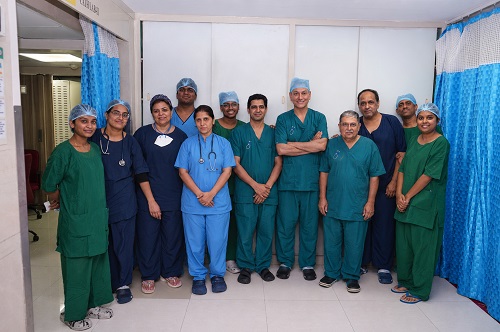 |
Centre L-R: Dr Malav Jhala, Dr Dhiraj Gupta, Dr Darshan Jhala & Dr Nitin Gokhale with cathlab and technical staff after India’s first combined PFA and LAAO procedure
Jagdip Shah a resident of Juhu in Mumbai had a longstanding history of heart failure following coronary artery bypass surgery performed several years agoOver time, he developed recurrent and debilitating episodes of atrial fibrillation (AF), the most common cardiac rhythm disorder and a major risk factor for strokeAF increases the risk of stroke by up to five times due to the formation of blood clots within the left atrial appendage (LAA), a small pouch in the heart.
To reduce this risk, the patient was prescribed oral anticoagulants (NOACs), at the lowest possible dosesHowever, each attempt at blood-thinning therapy resulted in severe gastrointestinal bleeding from stomach ulcers, often requiring blood transfusions and discontinuation of the medicationGiven his underlying condition and multiple comorbidities, the patient was at an increased risk of strokeHowever, his inability to tolerate blood thinners significantly complicated his management.
Hence, to resolve the issue, the multidisciplinary team led by Dr Dhiraj Gupta & including Dr Darshan Jhala, Dr Vivek Mehan, Dr Malav Jhala, Anaesthetists Dr Jay Kothari & Dr Madhuri Kharwadkar, Dr Nitin Gokhale, performed a complex combined procedure on 14th August involving Pulsed Field Ablation and Left Atrial Appendage OcclusionBy addressing atrial fibrillation and stroke risk in a single intervention, the team demonstrated its capability to deliver advanced, patient-centric care for high-risk cardiac cases.
Explaining the procedure, Dr Dhiraj Gupta, Visiting Cardiologist and Electrophysiologist, Lilavati Hospital and Research Centre, Mumbai, said, “Jagdip Shah presented a unique challenge with his age and multiple risk factors of stroke; episodes of bleeding made it difficult for him to remain on blood thinners for lifeOur objective was to address both the issues in a single procedureDuring the procedure, we eliminated the primary source of clot formation with LAAO and treated the abnormal heart rhythm with PFAThe minimally invasive approach allowed us to perform the case in one hour 30 minutes and provide a safe and more effective solution for the elderly, high-risk patient, helping reduce his stroke risk while improving his quality of lifeRecently introduced in India, pulsed field ablation (PFA) is becoming an innovative advancement in the field of field ablation treatment.”
Recalling his father’s journey, Kaushal Shah said, “For years my father lived with constant uncertaintyWhile he was taking the blood thinners, he faced a risk of serious bleeding, which affected his daily life and his confidence to live life freelySimple activities became a source of everyday worrySince undergoing the procedure, he has regained his confidence to get back to his routine and enjoy life without the same constant fearIt has given him and all of us a new sense of hopeWe are grateful to the medical team of Lilavati Hospital and Research Centre for giving him a chance to enjoy a better quality of life.”
“When the patient was reviewed two weeks later, on the 27th of August, imaging confirmed that the LAAO device was well positioned, and he was maintaining normal rhythm” added Dr Dhiraj.
This case showcases how multidisciplinary treatment, clinical expertise, and cutting-edge technology are improving outcomes for complicated cardiac patients in India.