

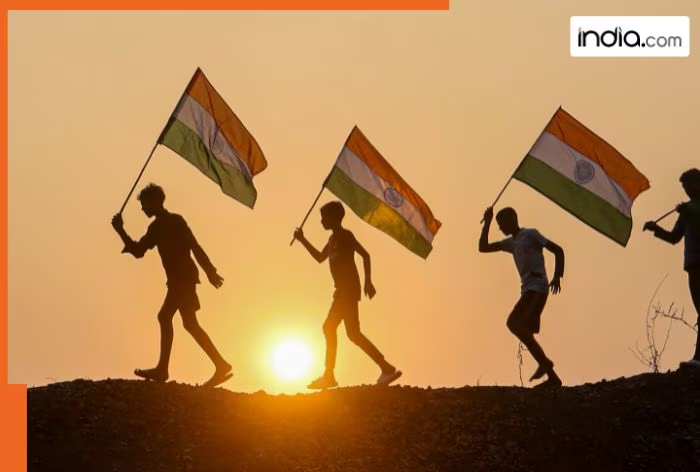
India will celebrate the 77th Republic Day on January 26, 2026. President Smt Droupadi Murmu will lead the celebrations from Kartavya Path, New Delhi,

Published: January 26, 2026 6:44 AM IST
Add India.com as a Preferred Source
The Indian Constitution is the longest handwritten constitution in the world. The final Constitution included 395 articles, divided into 22 parts and 8 Schedules. “It is the world’s lengthiest written Constitution which had 395 Articles, 22 Parts and 8 Schedules at the time of its commencement,” reads the press release.
The Constitution of India was not typeset or printed but was handwritten and calligraphic in both English and Hindi. It had 90,000 words. It was entirely handcrafted by the artists of Shantiniketan under the guidance of Acharya Nandalal Bose, with the calligraphy texts done by Prem Behari Narain Raizada in Delhi. The original copies of the Constitution of India are kept in special nitrogen filled receptacles in the Library of the Parliament of India.
Each part of the Constitution begins with a depiction of a phase or scene from India’s national history. At the beginning of each part of the Constitution, Nandalal Bose has depicted a phase or scene from India’s national experience and history. The artwork and illustrations (22 in all), rendered largely in the miniature style, represent vignettes from the different periods of history of the Indian subcontinent, ranging from Mohenjo-Daro in the Indus Valley, the Vedic period, the Gupta and Maurya empires and the Mughal era to the national freedom movement.
It took nearly 2 years, 11 months, and 18 days to draft the Constitution of India.
The preamble of the Constitution of India, the first page of the Indian Constitution, was inspired by the preamble of the United States of America. The Indian constitution was written in two languages – Hindi and English.
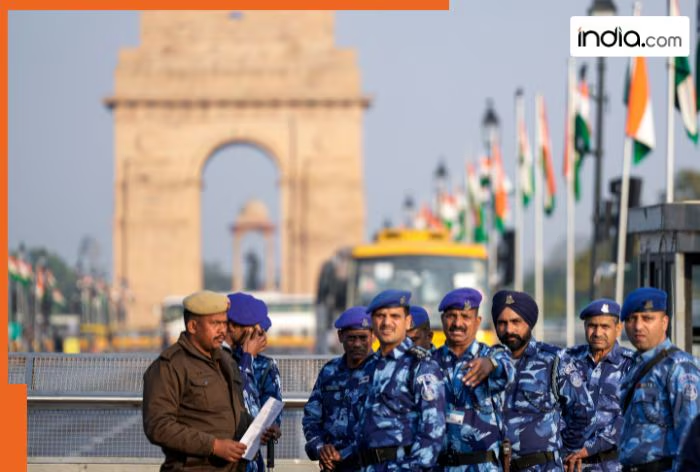
The Constitution was crafted by the Constituent Assembly, formed on December 6, 1946, to represent the nation’s diverse voices. The Constitution of India is often called a “bag of borrowings” because it contains many ideas from different countries. The French concepts of Liberty, Equality and fraternity, for example, were used as the basis for many of the fundamental principles in the Constitution of India. A grateful nation will celebrate the 77th Republic Day on January 26, 2026. President Droupadi Murmu will lead the celebrations from Kartavya Path, New Delhi, with the President of the European Council Mr Antonio Costa and the President of the European Commission Ms Ursula von der Leyen being the Chief Guests on the momentous occasion. The first Republic day parade was held in 1950 at the Irwin Amphitheater (now Major Dhyan Chand Stadium). From 1950 and 1954, the venues of the Republic Day parade were Red Fort, National Stadium, Kingsway, and Ramlila grounds. It was only in 1955 that Rajpath was chosen as the venue. As per the tradition, the National Flag will be unfurled, which will be followed by the National Anthem with a thunderous 21-gun salute using 105 mm Light Field Guns, an indigenously developed artillery weapon system. The 21-gun Salute will be presented by the 1721 Ceremonial Battery of the 172 Field Regiment. This salute is considered the highest symbol of military honour. Earlier The traditional Christian hymn ‘Abide with me’ was played during the Beating Retreat ceremony, but to promote Indian culture, it has now been replaced with Indian compositions and patriotic songs like “Aye Mere Watan Ke Logon.” On the first Republic Day in 1950, Indonesia’s President Sukarno was the chief guest.
Source link






Leave a Reply